Michelin named 94 Burgundy estates. We opened 33 of their websites: two sell a visit online, and none of the nine top domaines publish a bookable tour.
When an Argentine footballer's name appears on a bottle of Mendoza wine, it can mean four completely different things — and only one of them is a winery. The player may own the land and run the project. He may hold a stake in someone else's business. He may have licensed his name to a wine that a third party grows, makes and bottles. Or the label may be a collaboration: an established producer's wine, released under a shared name for a season or a contract.
Press coverage flattens all four into the same phrase — "his winery" — and that is where the confusion starts. For anyone actually planning a wine country trip the distinction is not pedantry. It decides whether there is a place to go at all. A licensed label has no address. A collaboration has an address, but it belongs to the winery that made the wine. Only an estate — land, vines, a plan for the fruit — is a destination in the sense a traveller means.
What follows sorts the best-documented Argentine football wine projects into those categories using each project's own published material, then does the more useful thing: reads the district names on the labels against Argentina's official register of geographical indications. That register turns out to contain a surprise, and it is the single most practical piece of information in this article.
The two projects that are genuinely estates
Two of the projects most often described as "a footballer's winery" publish enough technical detail on their own sites to be read as real viticultural undertakings: a named vineyard, a planting date, a density, a yield. Those numbers are the tell. A licensing deal has no reason to publish them, because there is no vineyard to describe.
Vinos de Potrero — Gualtallary, Uco Valley
The project of Nicolás Burdisso, the former Argentina and Boca Juniors defender, and Belén Soler Vallé. Their own site dates the beginning precisely: the first vineyard was bought in 2008, and the first wine was produced in 2012. Everything in the range comes from four small neighbouring vineyards of between 3.4 and 4.6 hectares in Gualtallary, in the Uco Valley — lots the estate describes as similar but deliberately not identical in soil and exposure, farmed the same way but bottled as distinct expressions.
The site is unusually specific about why that patch was chosen. Gualtallary sits at around 1,350 metres at the foot of Mount Tupungato; the soils are sandy loam with a high proportion of stones on and below the surface and a high limestone content; the lots face mainly north for sun exposure and slope eastward at close to 3%, so cool air drains away downhill. During the growing cycle, from October to April, the estate records Gualtallary as running the lowest temperatures of any winemaking area in the province — the reason its wines keep natural acidity at levels a warmer site could not.
The estate also supplies its own metaphor, and it is a good one. A vine needs a terroir poor enough to challenge it; a footballer, the site argues, needs a potrero — the rough, uneven, puddled scrap of ground where Argentine street football is learned. In both cases the poorer the surface, the better the result. That is where the name comes from, and it is a neater statement of the estate's philosophy than most wineries manage.
The Vinos de Potrero range. Every label is drawn from the four Gualtallary lots described above, which is why a single estate can bottle this many distinct expressions.
Cittanina — Las Compuertas, Luján de Cuyo
The estate of Lautaro Martínez and Agustina Gandolfo, and a completely different proposition from Potrero: not a young high-altitude planting but an old vineyard bought and taken on. The winery's own site records a historic Malbec vineyard planted in 1930 in the Las Compuertas district of Luján de Cuyo, at roughly 1,050 metres, trained on low trellis at 6,000 plants per hectare, surface-irrigated, and held to a naturally balanced 4,500 kg per hectare.
Those figures are worth reading slowly, because they say something the marketing does not. A yield of 4,500 kg per hectare is low. Vines planted in 1930 are approaching a century in the ground. Las Compuertas is among the coolest corners of Luján de Cuyo. Whatever brought the project into being, the farming decisions behind it are the decisions of people who intend to make serious wine rather than merchandise.
The first two labels, Pasión and Coraje, are both 100% Malbec from that vineyard, and they differ in how the fruit is picked rather than in what goes into the blend: Pasión is harvested in two passes, the first prioritising natural acidity and the second fruit; Coraje in three, adding a final pass for ripeness of tannin and polyphenols. Selective multi-pass picking on a single old parcel is a technique, not a story.
Cittanina bottles the Las Compuertas vineyard under its own name, and the estate presents itself as a lodge as well as a winery — the reason it reads as a destination rather than a brand.
How to read a back label in thirty seconds. Look for three things: a named district, a planting year, and a yield or density. If a bottle gives you all three, someone is farming. If it gives you a region as broad as "Mendoza" and an evocative sentence about passion, you are holding a brand — which may still be a perfectly good wine, but it is not a place you can visit.
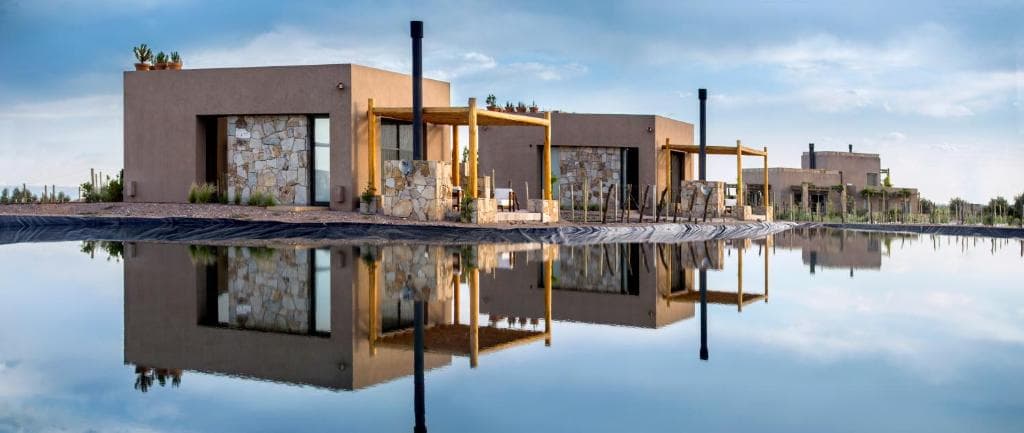
Mendoza's high-desert vineyards are what all of these labels ultimately point at. The property shown is a catalogue winery hotel, unconnected to any of the projects discussed here.
When the name is on the label but the winery belongs to someone else
The other two categories are just as common and far less often labelled correctly. Neither is a criticism — a well-made collaboration wine is a well-made wine — but they are a different kind of object, and they behave differently when you try to build a trip around them.
L10, the range associated with Lionel Messi, is listed on Bodegas Bianchi's own site as one of the winery's brands, alongside its house labels, with four wines under the name: L10 Premium, L10 Malbec, L10 Torrontés and L10 Extra Brut. That is the accurate description. The wine is Bianchi's — grown, made, bottled and sold by a long-established Mendoza producer with its own vineyards and its own winemaking team. The footballer's name identifies a range within that house, not a separate estate.
The L10 range, labelled "by Bianchi". These are Bodegas Bianchi's wines, grown and made at Bianchi's own facilities — the footballer's number names the range, not the producer.
GOAT 10, the other Messi range, goes a step further from Mendoza than most readers expect. When it launched, Decanter reported that the range comprised a Syrah and a Primitivo made in partnership with the Switzerland-based producer MM Winemaker, which has close ties to Italy, and that it followed an earlier collaboration with the same producer spanning Pinot Grigio, Nero d'Avola, Grillo, Chardonnay, Primitivo, Syrah, Cabernet Sauvignon and Merlot. Primitivo and Nero d'Avola are southern Italian varieties. The most widely publicised wine range attached to Argentina's most famous footballer is, on that account, not Argentine wine at all.
Say that plainly and the picture clarifies rather than deflates. There is an Argentine strand — a Mendoza house making Mendoza wine under a shared name — and an international strand that happens to carry the same person's number. Only the first has anything to do with a trip to Mendoza.
A licensed or collaborative label still has to be made and aged somewhere — usually in an established winery's cellar, under that winery's name on the paperwork.
"In collaboration with" on a front label is a legally meaningful phrase and it is doing exactly what it says. The producer named in small type on the back — the one with the establishment number — is the party responsible for the wine. That is also the only party with a cellar door.
The map hidden in the labels — and one famous name with no legal standing
Strip the names off these bottles and what is left is a short list of Mendoza districts: Gualtallary, Las Compuertas, Luján de Cuyo, the Uco Valley. Checked against the Instituto Nacional de Vitivinicultura's published register of recognised and protected geographical indications and denominations of origin, that list divides in a way almost nobody mentions.
Las Compuertas — a registered Indicación Geográfica in Luján de Cuyo, Mendoza. The district on Cittanina's label is an official one.
Agrelo — likewise a registered IG in Luján de Cuyo, and the neighbouring district you will meet constantly on Mendoza labels.
Luján de Cuyo — appears twice in the register: as an IG, and separately as a D.O.C., Argentina's stricter tier. What that second entry actually demands is set out in our guide to Malbec's two rulebooks.
Tupungato — Valle de Tupungato — an IG recognised by INV Resolution C.32/2002, with Resolution C.20/2006 recognising Tupungato and Valle de Tupungato as synonyms.
Valle de Uco — registered as an interjurisdictional zone made up of the departments of San Carlos, Tunuyán and Tupungato, under INV Resolution C.37/2002.
Gualtallary — does not appear in the register at all.
That last line deserves a paragraph of its own, because Gualtallary is arguably the most fashionable vineyard name in South America. Producers use it on labels and in technical sheets, including Vinos de Potrero, which prints "IG Gualtallary" on its own material. But the INV list of recognised and protected indications — the document that says what the state actually stands behind — does not include it. What is recognised for that ground is the wider Valle de Tupungato, and above that the Valle de Uco zone.
This does not make Gualtallary wine worse, and it is not an accusation against anyone. It means something more precise and more useful: when the word appears on a bottle, the guarantee behind it is the producer's reputation, not a regulator's boundary. On a bottle marked Las Compuertas or D.O.C. Luján de Cuyo, it is the other way round. Knowing which of those two things you are being sold is exactly the sort of literacy that makes a wine tasting trip worth the airfare.
Everything worth knowing about a Mendoza wine's origin is printed in small type on the back, and most of it is a district name you can check against the national register.
IG and D.O.C. are not two words for the same thing. An Indicación Geográfica delimits an origin. A Denominación de Origen Controlada adds binding rules on top — grape percentage, vine age, yield, ageing, bottling at origin. Argentina has dozens of the first and very few of the second.
Can you actually visit any of it?
This is where the taxonomy stops being an intellectual exercise. Checked on their own websites, neither Vinos de Potrero nor Cittanina publishes a public visit or tasting-booking page. Potrero's site offers wines, terroir, an about section, a contact form and a retail link; Cittanina's offers a story, the vineyard, the wines and a contact form. Neither has an opening-hours line or a reservation button.
The honest reading of that is narrow and worth stating carefully: there is no published public route in. It is not evidence that either estate never receives anyone, and a traveller who wants to try should write to the address on the contact form rather than turn up. But a trip cannot be planned around a door that has no published hours.
The irony is that the visitable project is the collaboration. Bodegas Bianchi — the house behind L10 — publishes two winery addresses with contact numbers: the original bodega in San Rafael, and Bodega Enzo Bianchi at Vista Flores, in the Uco Valley. That is a working address in wine country, which is more than either footballer-owned estate offers the public.
So do what experienced visitors to Mendoza do anyway: go for the district, not the name. The ground that produced these labels is entirely open to visitors even where individual estates are not. Las Compuertas, Vistalba, Perdriel, Agrelo and Chacras de Coria sit within a short drive of each other in Luján de Cuyo, most of them with wineries that do publish tasting hours. For the Uco Valley side, our guide to Tupungato covers the approach to the high-altitude frontier the Gualtallary bottles come from.
Plan around districts. Las Compuertas, Vistalba, Perdriel, Agrelo and Chacras de Coria are all Luján de Cuyo, all within a compact radius, and collectively hold far more open cellar doors than any single famous name.
Treat the cult estate as a bonus, not an anchor. If a reply to your email comes back, brilliant. Build the itinerary so it does not matter if it does not.
Ask who made it, not who signed it. At any tasting, the useful question about a celebrity label is which establishment number is on the back. The answer places the wine on the map in one sentence.
Where to stay in the districts the labels point to
Both genuine estates sit inside a remarkably small area. Cittanina's 1930 vineyard is in Las Compuertas, in the northern reach of Luján de Cuyo; the surrounding districts — Vistalba and Chacras de Coria in particular — are where the concentration of vineyard hotels in this part of Argentina actually is. Potrero's lots lie further south and considerably higher, in the Uco Valley, reached from the same base in a long morning's drive.
That geography makes the accommodation decision simple. A single base in Luján de Cuyo covers the old-vine districts on foot or by short taxi and puts the Uco Valley within a comfortable day trip, which is why almost every Mendoza winery hotel in our catalogue is clustered there rather than spread across the province.
Vistalba, in Luján de Cuyo — the district next to Las Compuertas, and the practical base for visiting the old-vine ground these labels come from.
Hotel
4.4(865 reviews)
Villa Mansa
Mendoza, Luján de Cuyo, Argentina
Starting from
$160 /night
Hotel
4.8(133 reviews)
Finca Adalgisa
Mendoza, Luján de Cuyo, Argentina
Starting from
$420 /night
Hotel
4.8(707 reviews)
Lares de Chacras
Mendoza, Luján de Cuyo, Argentina
Starting from
$149 /night
Hotel
4.6(1,025 reviews)
Rosell Boher Winery Lodge & Spa
Mendoza, Luján de Cuyo, Argentina
Starting from
$630 /night
Hotel
4.6(1,055 reviews)
Entre Cielos Wine & Wellness Hotel
Mendoza, Luján de Cuyo, Argentina
Starting from
$417 /night
Hotel
4.6(1,503 reviews)
Club Tapiz
Mendoza, Maipú, Argentina
Starting from
$170 /night
Villa Mansa sits in Vistalba, the district immediately adjacent to Las Compuertas. Finca Adalgisa and Lares de Chacras are both in Chacras de Coria, the leafy village on the city side of the same department. Rosell Boher Winery Lodge & Spa is set in Luján de Cuyo vineyards roughly 45 km from Mendoza city. Entre Cielos and Club Tapiz round out the cluster with vineyard stays that build tastings into the stay itself.
If the point of the trip is old Malbec, come in late February to early April, when the fruit is actually being picked and cellars are working. Mendoza's Vendimia festival falls in the same window and fills rooms across Luján de Cuyo, so book the hotel before you book anything else.
What the football actually tells you about Mendoza
Set the names aside and look at where the money went. Two players with the resources to buy vineyards anywhere in Argentina bought in two specific places: an old, cool, low-yielding parcel in Las Compuertas, and four small stony lots at 1,350 metres in Gualtallary. Those are not random purchases. They are the two arguments Mendoza has been making about itself for twenty years — that its best old ground is in the northern districts of Luján de Cuyo, and that its most interesting new ground is as high up the Uco Valley as vines will ripen.
That is the real content of the story. The celebrity labels are a way in; what they lead to is a province where the interesting distinctions are between districts a few kilometres apart, where one of the most sought-after vineyard names is not in the national register, and where a vineyard stay in a single Luján de Cuyo village puts most of it within reach. Football gets you reading the label. The label, read properly, gets you a much better trip.
Sources & Further Reading
Registers and producer information change. The INV register in particular is revised as new indications are recognised — Gualtallary's absence is accurate to the edition linked below, and anyone relying on it for a commercial purpose should re-check the current version before quoting it.
Vinos de Potrero — official site (English) — source for the 2008 purchase of the first vineyard and the first wine in 2012, the four neighbouring lots of 3.4 to 4.6 hectares, the Gualtallary location at 1,350 metres at the foot of Mount Tupungato, the sandy loam and limestone soils, the northern exposure and roughly 3% eastward slope, the October–April temperature claim, the terroir and potrero metaphor, and the absence of any published visit-booking page.
Cittanina — official site (English) — source for the historic Malbec vineyard planted in 1930 in Las Compuertas, Luján de Cuyo, at 1,050 metres, the low trellis at 6,000 plants per hectare with surface irrigation, the 4,500 kg per hectare yield, the Pasión and Coraje labels as 100% Malbec and their two- and three-pass harvests, and the absence of any published visit-booking page.
Bodegas Bianchi — L10 range page — source for L10 being a Bodegas Bianchi brand and for the four wines carried under the name: L10 Premium, L10 Malbec, L10 Torrontés and L10 Extra Brut.
Bodegas Bianchi — Valle de Uco winery — source for the winery publishing working addresses with contact details in San Rafael and at Vista Flores in the Uco Valley.
 Alex Osso

 Build your own directory