Michelin named 94 Burgundy estates. We opened 33 of their websites: two sell a visit online, and none of the nine top domaines publish a bookable tour.
Malbec is a black-skinned French wine grape whose official prime name is not Malbec at all — it is Côt. That is how the Vitis International Variety Catalogue, the reference register maintained by the Institute for Grapevine Breeding at Geilweilerhof in Germany, files it: variety number 2889, prime name COT, berry skin noir, country of origin France, utilization wine grape. Malbec is listed there too — as one synonym among 194.
Its parentage is not folklore either. VIVC records the cross as Magdeleine Noire des Charentes × Prunelard, and files it under "pedigree confirmed by markers" rather than as a claim from the literature. Both parents are old south-western French varieties, which puts the grape's birthplace firmly in the French south-west rather than in Argentina, where most people now first meet it.
What makes Malbec unusually interesting for anyone planning a wine countrytrip is that two different regulators, on two continents, have written two different legal definitions of what a Malbec wine has to be. In France, the appellation built on it demands a minimum of 70% of the variety. In Argentina, the appellation built on it demands a minimum of 85% — plus a minimum vine age, a minimum alcohol level and a minimum time in oak. Neither rulebook is the "real" one. They are two answers to the same grape, and reading them side by side tells you more about what will be in your glass than any tasting note.
One grape, 194 names — and the map hidden inside them
The synonym list on the VIVC passport page is not trivia. It is a record of everywhere the variety was planted and what the locals decided to call it, and it reads like a route map of French viticulture before the phylloxera era.
Auxerrois, Quercy, Cahors — the names used in and around the Lot valley, where the grape became the backbone of a single appellation.
Noir de Pressac, Pressac, Saint-Émilion, Médoc Noir, Bordelais Noir — the Bordeaux names. Malbec is a Bordeaux variety with a long history there, a fact the synonym list makes hard to argue with.
Côt de Touraine, Grelot de Tours — the Loire names.
Malbeck, Malbech, Malbek — the spellings that travelled, and the one that eventually stuck on labels almost everywhere outside France.
The practical consequence for a traveller: a bottle labelled Côt in the Loire, a bottle labelled Cahors in the Lot, and a bottle labelled Malbec in Mendoza are all the same variety. The differences you taste come from climate, altitude, vine age and the rulebook — not from genetics.
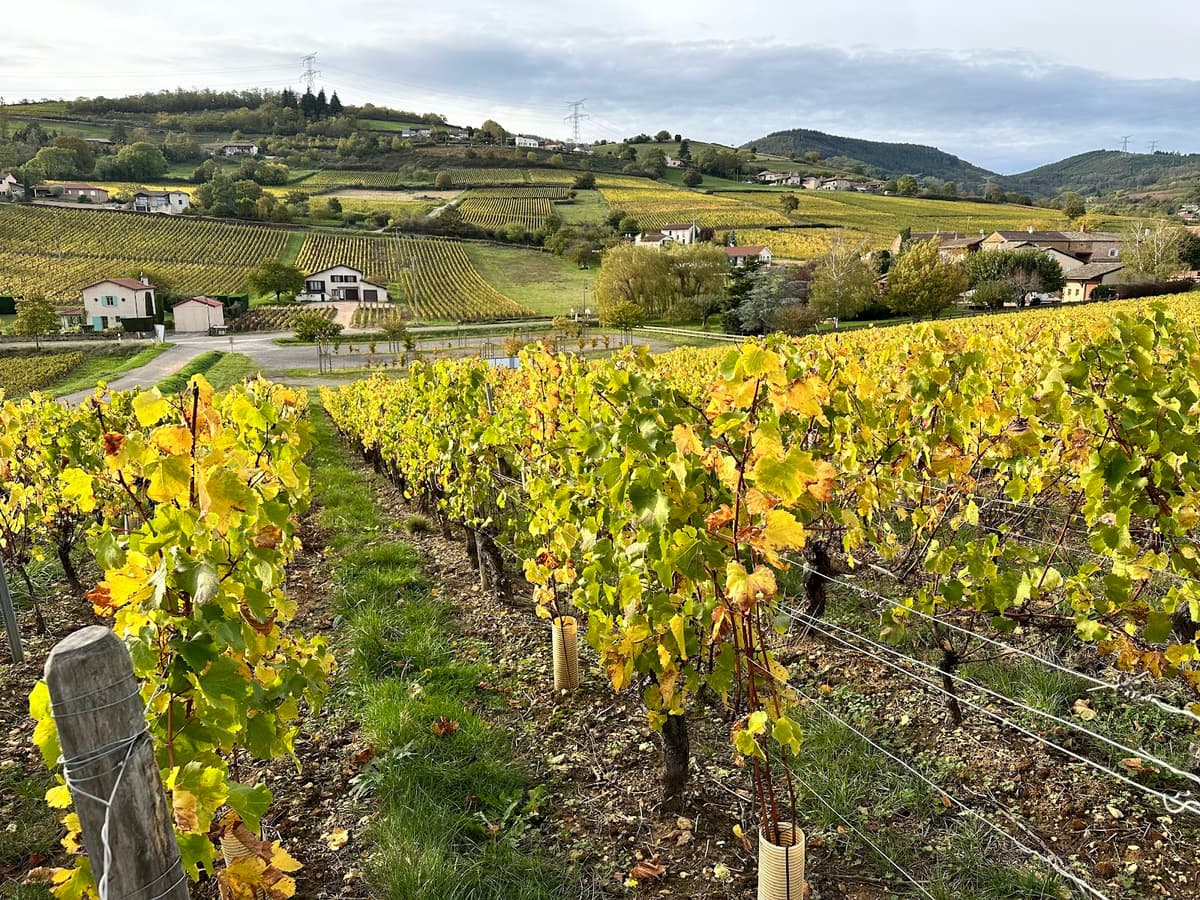
Vine rows in Saint-Émilion. Bordeaux gave the grape several of its 194 recorded names — Noir de Pressac, Médoc Noir and Saint-Émilion among them — long before Argentina made "Malbec" the label the world reads. The vines pictured are not identified by variety.
If you are reading a French label and cannot find the word Malbec anywhere, look for Côt, Auxerrois or simply the appellation name. French labelling leads with place; varietal labelling is largely a New World habit.
Cahors: what the French rulebook actually requires
AOC Cahors was first recognised by decree on 15 April 1971. Its cahier des charges — the specification every producer must meet — is short, specific, and much stricter than the grape's reputation as a rustic country red would suggest. The headline points:
Red still wines only. There is no white or rosé Cahors under the appellation.
Côt N is the principal variety; Merlot N and Tannat N are the only permitted accessory varieties. Côt must be at least 70% of the plantings, assessed across all the estate's parcels producing the appellation wine — and the finished blend must likewise be pure Côt or contain a minimum of 70% of it.
A defined area of 45 communes in the Lot department, plus a small immediate proximity zone where vinification and ageing may be carried out by derogation.
Minimum planting density of 4,000 vines per hectare, rows no more than 2.50 m apart, vines 0.90–1.30 m apart within the row.
Base yield 50 hl/ha, hard ceiling 60 hl/ha, with a maximum average load of 8,500 kg per hectare — dropping to 6,500 kg where irrigation is permitted.
Minimum sugar at harvest of 193 g per litre of must and a minimum natural alcohol of 11.5%.
Destemming is compulsory. Malolactic fermentation is compulsory, with residual malic acid capped at 0.4 g/l. There is even a minimum colour intensity — the sum of optical densities at 420, 520 and 620 nanometres must reach 11.
Ageing until at least 1 March of the year following the harvest, with release to the consumer no earlier than 15 March.
Read that list again and notice what it does not say. It does not require oak. It does not require a minimum vine age. It sets a floor on ripeness and a floor on colour, then largely leaves the cellar alone. That is a very French way of writing a rulebook: define the place, the plant material and the crop, and let the winemaker answer for the rest.
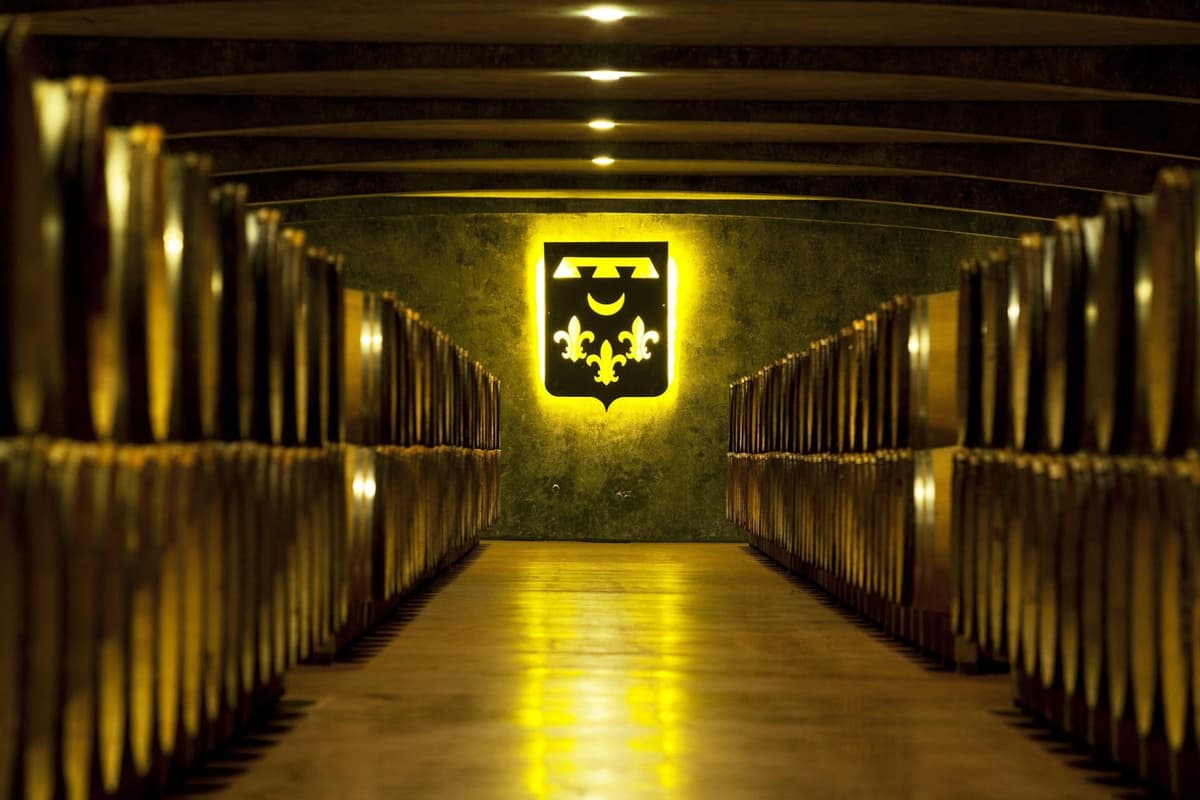
A barrel cellar in Bordeaux. The Cahors specification sets a date before which the wine may not be sold — 15 March following the harvest — but, unlike the Argentine rulebook further down this page, it never mentions wood at all.
"Cahors" on a label is a place, not a grape, and "Malbec" on a label is a grape, not a place. A Cahors is always at least 70% Malbec; a Malbec is not necessarily from anywhere in particular. Both statements matter when you are choosing what to bring home.
How Malbec reached Argentina — and why the date is 17 April
Argentina's national Malbec celebration falls on 17 April, and the date is not a marketing invention pulled out of the air. It commemorates the day in 1853 when the French agronomist Michel Aimé Pouget, engaged at the instigation of the statesman Domingo Faustino Sarmiento, presented a project to the Provincial Legislature of Mendoza to establish a Quinta Normal and agricultural school. That project — approved by the House of Representatives on 6 September of the same year — was the vehicle through which Malbec first arrived in the country.
Malbec World Day itself is much younger: it was first held on 17 April 2011, a global initiative created by Wines of Argentina and supported by the Ministry of Foreign Affairs, the Argentine investment and trade agency, and COVIAR. If you are planning a trip around it, note that the programme runs across the whole of April rather than a single day, and that the biggest fixture in the Mendoza calendar is a different event entirely — the Fiesta Nacional de la Vendimia, which falls at harvest in late summer.
The numbers that made Malbec Argentina's grape
Argentina's wine regulator, the Instituto Nacional de Vitivinicultura, publishes a dedicated Malbec report. The edition released in April 2026, covering the position at the close of 2025, gives the scale of what happened after 1853:
46,890 hectares of Malbec planted in Argentina at the end of 2025.
42.6% of all red wine grape varieties suitable for winemaking, and 23.9%of the country's total vineyard area — close to one vine in four.
54% of all varietal wine sold on the domestic market, at 1,268,186 hectolitres in 2025, up 2.4% year on year. Bottled format accounts for 98.4% of that volume.
1,172,721 hectolitres exported as Malbec and Malbec blends, earning USD 404.7 million and representing 71.9% of the total volume of Argentine varietal wine exported, shipped to 114 countries. The United Kingdom took 33.8% and the United States 21.2%.
Those last two lines are the reason the grape looks ubiquitous abroad. Roughly seven out of ten bottles of Argentine varietal wine leaving the country are Malbec, which is why a wine shop in London or Chicago can give you the impression that Argentina grows nothing else. It does — the INV publishes equivalent reports on Bonarda and on the white varieties — but the export mix is heavily weighted towards one grape.
Bottles laid down in a Mendoza cellar, the vintage chalked on a slate. Marking the rack by variety and year is how a small estate keeps track of a wine that will not be released for years.
DOC Luján de Cuyo: the other rulebook
Argentina's answer to the appellation idea sits about twenty kilometres south of Mendoza city. The Consejo of the Denominación de Origen Controlada Luján de Cuyo was created in 1989; its rulebook and legal personality followed in 1990, and the International Organisation of Vine and Wine recognised it in 1991. It became provincial law in 1993 and national law in 1999, with the national law regulated in 2004. By the Consejo's own account it was the first Denominación de Origen Controlada in the Americas.
What it demands of a wine is considerably more prescriptive than Cahors:
Malbec at a minimum of 85%, with the remaining 15% drawn from varieties authorised in the rulebook.
The vineyard must be at least ten years old, trellised, and planted at more than 5,000 vines per hectare — a vine-age requirement Cahors does not impose.
Grapes from Luján de Cuyo, approved by the Consejo, with the wine produced and bottled at origin.
Minimum alcohol of 13.5% — a floor two full percentage points above the Cahors minimum, and a direct consequence of ripening fruit at altitude in a dry climate.
Eighteen months between harvest and market release, of which at least six months in wood. This is the clause that most clearly separates the two systems.
Regulated labelling and a numbered official seal for traceability, with permanent oversight by the Consejo and the INV through technical committees working in the vineyard, in the winery and on the finished product.
Since 2023 there is a second, stricter tier: Vinos de Selección Distrital, drawn from a single district within Luján de Cuyo. Those wines must age for no less than 24 months, with at least 12 of them in oak, and their production is capped at 70 quintales — 50 hectolitres of free-run must — per hectare per year. They carry a gold seal and must name the district on the label. The districts you will see are Agrelo, Drummond, Las Compuertas, Perdriel and Vistalba.
Large wooden vessels in a Mendoza cellar. Time in wood is written into the DOC Luján de Cuyo rulebook — six months minimum for a DOC wine, twelve for a district selection — which is not true of the French appellation the grape came from.
The numbered seal is the thing to look for on a shelf in Mendoza. It is the only visible marker that separates a DOC Luján de Cuyo bottle from the very much larger number of Argentine wines labelled simply "Malbec, Mendoza", which carry no such requirements at all.
What the two rulebooks tell you before you taste anything
Put the two specifications side by side and the contrast is sharper than any "Old World versus New World" generalisation.
Cahors regulates the vineyard hard and the cellar lightly. Density, spacing, pruning, crop load, yield ceiling, sugar at harvest — all fixed. Then destemming and malolactic fermentation, a colour minimum, a release date, and nothing about barrels.
Luján de Cuyo regulates both, and adds time. A minimum vine age, a higher varietal floor, a higher alcohol floor, mandatory estate bottling, and a compulsory stretch in oak before anyone may buy it.
Neither is a quality ranking. As with Italy's DOCG, DOC and IGT tiers, these are rule sets. A producer may make a superb Malbec in Luján de Cuyo and decline to certify it, because the rulebook forbids something they want to do.
For a visitor this is genuinely useful. If you sit down at a tasting bar in Mendoza and the wine in front of you carries the DOC seal, you already know it came off vines at least a decade old, reached 13.5% naturally, and spent half a year in wood before anyone was allowed to sell it. If the same estate pours you an uncertified single-vineyard bottling alongside it, that is a deliberate choice worth asking about — and it is a far better question than "what does it taste like".
Where to stay in Malbec country
Luján de Cuyo and neighbouring Chacras de Coria sit close enough to Mendoza city that you can base yourself among the vines without giving up restaurants, and close enough to the Uco Valley that a day out to Tupungato is straightforward. These are winery hotels and vineyard stays in our catalogue for Argentina:
Hotel
4.6(1,055 reviews)
Entre Cielos Wine & Wellness Hotel
Mendoza, Luján de Cuyo, Argentina
Starting from
$417 /night
Hotel
4.6(1,503 reviews)
Club Tapiz
Mendoza, Maipú, Argentina
Starting from
$170 /night
Hotel
4.8(133 reviews)
Finca Adalgisa
Mendoza, Luján de Cuyo, Argentina
Starting from
$420 /night
Hotel
4.8(707 reviews)
Lares de Chacras
Mendoza, Luján de Cuyo, Argentina
Starting from
$149 /night
Hotel
4.4(865 reviews)
Villa Mansa
Mendoza, Luján de Cuyo, Argentina
Starting from
$160 /night
Hotel
4.6(1,025 reviews)
Rosell Boher Winery Lodge & Spa
Mendoza, Luján de Cuyo, Argentina
Starting from
$630 /night
A terrace looking over the vines at Chacras de Coria. Staying inside the appellation is the simplest way to visit more than one estate a day without a long drive back to the city.
Argentine harvest runs roughly February to April, which is also when the Vendimia festival fills Mendoza. If your trip is built around seeing fruit come in, book accommodation early; if it is built around unhurried tastings, the months either side are calmer.
For the French side of the story, the grape's home appellation in the Lot is a small, rural, comparatively unvisited corner of France — a very different proposition from the polished wine tourism of Bordeaux an hour and a half to the west, where the same variety has quietly been part of the blend for centuries under a different name.
Sources & Further Reading
Every figure, rule and date above comes from the body that issued it: the variety register for identity and parentage, the French appellation specification for Cahors, the Consejo's own rulebook for Luján de Cuyo, and Argentina's wine regulator for the statistics. Vineyard areas and trade figures are annual and will move; appellation specifications are amended from time to time. Treat both as current at the time of publication and check the source before quoting a number.
Vitis International Variety Catalogue — passport page for COT (variety number 2889) — source for the prime name Côt, the French country of origin, the black berry skin, the classification as a wine grape, the count of 194 synonyms and the individual synonyms quoted, and for the parentage Magdeleine Noire des Charentes × Prunelard being recorded as confirmed by markers rather than merely reported.
Cahier des charges of the AOC Cahors — the official specification text, as published by Vignobles Occitanie — source for the 15 April 1971 recognition, red wines only, Côt N as principal variety with Merlot N and Tannat N as accessories, the 70% minimum in both plantings and blend, the 45 communes of the Lot, the 4,000 vines per hectare and row-spacing rules, the 50 and 60 hl/ha yields, the 8,500 kg/ha crop load, the 193 g/l sugar and 11.5% natural alcohol minimums, compulsory destemming and malolactic fermentation, the colour-intensity floor, and the 1 March ageing and 15 March release dates.
Consejo D.O.C. Luján de Cuyo — official site of the denomination — source for the 85% Malbec minimum, the ten-year minimum vine age, trellising and the 5,000 vines per hectare density, origin bottling, the 13.5% minimum alcohol, the 18-month/6-month ageing rule, the numbered seal and joint Consejo–INV oversight, the Distrital tier introduced in 2023 with its 24-month and 12-month oak requirements and its 70 quintal / 50 hl per hectare cap, the five named districts, and the timeline from the Consejo's creation in 1989 through OIV recognition in 1991 to national law in 1999.
Instituto Nacional de Vitivinicultura — Informe Malbec 2026 (published 15 April 2026) — source for the 46,890 hectares at the close of 2025, the 42.6% share of red varieties and 23.9% of total vineyard area, the 54% share of domestic varietal sales at 1,268,186 hl and the 98.4% bottled share, and the export figures: 1,172,721 hl, USD 404.7 million, 71.9% of varietal export volume, 114 countries, United Kingdom 33.8% and United States 21.2%.
Argentine Ministry of Foreign Affairs — Malbec World Day — source for the 17 April 1853 presentation of Michel Aimé Pouget's Quinta Normal project to the Provincial Legislature of Mendoza at Sarmiento's instigation, its approval by the House of Representatives on 6 September 1853, and for Malbec World Day having been first celebrated on 17 April 2011 as a Wines of Argentina initiative.
 Alex Osso

 Build your own directory