Can You Actually Visit a MICHELIN Grape Estate? We Checked All Their Websites
Michelin named 94 Burgundy estates. We opened 33 of their websites: two sell a visit online, and none of the nine top domaines publish a bookable tour.
The short answer: almost none of them, and not the famous ones
On 7 July 2026 the MICHELIN Guide published its first wine selection at the Palace of the Dukes of Burgundy in Dijon: 94 estates across the Côte de Nuits, the Côte de Beaune and the Côte Chalonnaise. Within a week the list was circulating as a travel itinerary. It is not one.
We opened the published websites of 33 of the 94: all nine estates at Three grapes, plus a deliberately mixed sample from the other three tiers. We looked for one thing only. Can a member of the public book a visit?
Two of the 33 sell a tour and tasting through a booking module on their own site. Eleven receive visitors on request, one of those for the wine trade only. Thirteen publish nothing at all about visits. Five have no website we could find, and a sixth has nothing behind its address but a recently built marketing page with no way to contact anyone.
Among the nine estates at the top of the selection, the number publishing a bookable visit is zero.
That is not a scandal. Nor is it an oversight. A MICHELIN grape rates the wine a producer makes; it says nothing whatsoever about whether that producer has a tasting room, a car park or any interest in meeting you. We set that distinction out in full in our explainer on what the MICHELIN grape actually measures. This article is the practical companion to that one: what the list means for a trip, and what to do with the ten days you were about to spend knocking on doors in Vosne-Romanée.
How we checked, and what a blank page does not prove
One rule governed the whole exercise: only the estate's own website counts. Not TripAdvisor, not a tour operator's inventory, not a booking aggregator that lists a domaine it has no relationship with. If the winemaker has not published it, we did not record it.
That rule cuts both ways. The second half matters more. When an estate's site has no visits page, the honest finding is no public booking channel is published, not "the domaine refuses visitors". Plenty of Burgundy runs on the telephone, on the importer relationship, on the friend of a friend. A silent website is silence, not a closed door.
So we report a refusal only where the estate states one itself. Across 33 estates, exactly one does.
A site that will not load is a third thing again, and we kept it separate rather than counting it as silence. Three of the addresses here answer only over plain http, one of them with a security certificate issued to somebody else's server, so a browser refuses the page before the estate gets a chance to say anything. That is a hosting problem, not a policy. Where we hit one we went round it, over http or through the redirect, and say below what we found when we got in.
Everything below was read from the estates' own sites in early September 2026. Opening arrangements in Burgundy change with the vintage, the allocation and the harvest calendar — treat any schedule here as a starting point and confirm directly before you travel.
The top of the list is a wall, and it says so quietly
Nine estates hold Three MICHELIN grapes: Cécile Tremblay, Dugat-Py, Roumier, Domaine de la Romanée-Conti and Domaine Leroy in the Côte de Nuits; Domaine d'Auvenay, Coche-Dury, Jean-Marc & Thomas Bouley and Hubert Lamy in the Côte de Beaune. Here is what their websites offer a traveller.
Start with the two that are not there at all.
Coche-Dury in Meursault and Domaine d'Auvenay in Saint-Romain publish nothing we could find. The domains a visitor would guess at are parked or listed for sale, so they cannot be cited and should not be trusted. The most famous white-wine address in the Côte de Beaune has no digital front door.
Domaine de la Romanée-Conti does have a site, and it will tell you almost anything except how to reach it. The navigation runs through the families, the nine grands crus, tasting notes, vintages, fifteen hundred years of history and a counterfeit warning. No contact page. No form. No email address published anywhere on it. Roumier goes one step further in usefulness and one step back in openness: its site is essentially a distributor list plus a login for existing customers, and the only contact detail published anywhere is a telephone number in the legal notice.
Domaine Leroy took the longest to pin down. Its own address, domaineleroy.com, refuses a secure connection outright; over plain http it forwards to domaine-leroy.fr, five pages of philosophy, history, vineyards and vintages, with no contact page and nothing about visiting. We went and looked rather than writing the estate off as absent. A closed site and a misconfigured server are not the same finding.
Three estates publish a way to reach them and nothing about coming round.
Cécile Tremblay's contact page offers a single mailto link. Dugat-Py lists a phone number, an address and an email, then routes buyers to a retailer and importer list spanning France and some twenty-eight export markets. Hubert Lamy publishes a phone number, an email and a form headed "Demande de renseignements" — an information request, not a booking. There is a photograph of a caveau on the homepage and no published terms of access to it.
Only one of the nine says it plainly. Jean-Marc & Thomas Bouley in Volnay states its position in its own words: "La réorganisation du travail au Domaine ne permet plus de recevoir pour des dégustations" — the reorganisation of work at the estate no longer allows it to receive people for tastings. A form, a phone number and a distributor page remain. That is a clear answer, and it is worth more to a traveller than eight ambiguous ones.
The pattern is consistent enough to be the finding. Estates at this level sell everything they make through allocation, often years ahead. A tasting room is a cost with no commercial upside, and hosting strangers competes directly with the work that earned the distinction. The Guide itself has been on the receiving end of the same logic: as we covered in our breakdown of the selection map, Arnoux-Lachaux formally asked to be removed from the guide altogether.
The middle of the list is where Burgundy opens up, on request
Move down the tiers and the doors start to move. Not swing open, exactly. Burgundy's default is sur rendez-vous, and the phrasing is remarkably uniform across the region.
Bruno Clair in Marsannay-la-Côte asks visitors to "reserve in advance if you would like to avail of wine tasting at the estate". Domaine Rapet in Pernand-Vergelesses publishes the most precise version of the formula: the caveau is open Monday to Friday by appointment, closed weekends and public holidays. Alain Gras in Saint-Romain heads a section "Caveau de dégustation" and puts two words under it: uniquement sur rendez-vous. Henri & Gilles Buisson, also in Saint-Romain and pioneers of organic viticulture in Burgundy since the late 1940s according to the Guide, sets the same line in quotation marks on its own contact page. Camille Thiriet, the newest estate in our sample, built up from a micro-négociant operation in a garage in Comblanchien, says simply "Nous recevons exclusivement sur rendez-vous" on the front page.
Two entries in this group deserve reading carefully, because they look like invitations and are not. Bonneau du Martray in Pernand-Vergelesses publishes "Visits reserved for professionals & by appointment only" — that is a trade appointment, and a private traveller should not read it as an offer. Domaine Berthaut-Gerbet in Fixin is more open: by appointment, weekday mornings and afternoons, except Wednesday afternoon. Then it adds, in the same breath, that availability is very limited with the 2024 vintage coming, and reserved to regular clients. Read that as a queue, not a door. What it does publish for everyone is a village event: open cellars in Fixin on 5 and 6 December 2026. More on that approach below, because it is the single best answer in this article.
In the Côte Chalonnaise, Bruno Lorenzon in Mercurey adds a seasonal restriction few visitors anticipate: "Notre domaine n'est ouvert que sur rendez-vous de novembre à mai" — appointments only, and only between November and May. Turn up in high summer and there is nothing to turn up to. Dureuil-Janthial in Rully publishes the same appointment-only line, but its website is currently serving injected spam links, so we are not linking to it here.
Then there is the group that publishes nothing about visits at all despite maintaining a perfectly good site: Dujac in Morey-Saint-Denis, Domaine Leflaive in Puligny-Montrachet,Clos de Tart, Domaine des Lambrays, Château de la Tour in Vougeot, Bouchard Père & Fils. Château de la Tour is the one your browser will argue with. The secure version of its address serves a certificate belonging to its hosting company; the page waiting behind plain http is a single scroll of cuvée notes, with no contact anywhere on it.
Then a final group with no findable website whatsoever — Domaine des Croix, Sylvain Pataille and Maxime Cottenceau, the young Montagny grower the Guide singles out as one of southern Burgundy's most promising. For those three, the only online presence is an importer's catalogue. Domaine des Comtes Lafon is the near miss. comtes-lafon.com does resolve, and what loads is a recently built marketing page: a Dominique Lafon quote, a paragraph of history, a FAQ aimed at buyers. No address, no contact form, not one word about the cellar.
If a booking site offers you a "private tasting" at a domaine whose own website has no contact page, ask what exactly you are buying. In Burgundy the reseller is frequently selling access to a négociant cellar or a wine shop, with the famous name attached to the itinerary rather than to the appointment.
Where you can genuinely book a cellar visit today
Two estates in our sample of 33 put a booking module on their own website, and both are in the same category: long-established houses in Beaune and Nuits-Saint-Georges with the scale to run hospitality as a real department.
Joseph Drouhin publishes it plainly: the Oenothèque "offers, by appointment, visits to the historic cellars followed by different tastings". The catalogue can be browsed and reserved in French or English, Monday to Saturday, year-round apart from the Christmas and New Year weeks. Its Beaune boutique page adds vineyard outings by vehicle or electric bike, food-and-wine pairings and vertical tastings, all on reservation.
Nuits-Saint-Georges has its equivalent. Faiveley runs the same kind of booking catalogue, with one detail worth knowing before you choose a slot: tours are sold as language-specific products, so a French tour and an English tour are separate bookings. The house also states that all proceeds from its tours and tastings go to two charities: the Château du Clos de Vougeot and the Rodin Museum. That closes a very Burgundian circle, since the Clos de Vougeot is itself one of the best visits in the region.
Louis Jadot sits just short of that: it publishes a real, specific offer: tours at 3 pm Monday to Friday and 10 am on Saturdays, by appointment only, with a dedicated visits email address, but no online reservation. Its wineshop keeps its own hours, including a Wednesday that opens only in the afternoon. And Domaine Trapet in Gevrey-Chambertin routes its hospitality through the family's guest house rather than the winery site: commented tasting sessions accompanied by a visit of the facilities, in two daily slots, Tuesday to Saturday in the late-summer window and Saturdays only thereafter. It is the clearest illustration in this whole exercise of a pattern worth internalising. In Burgundy, the hospitality and the wine often live at different addresses.
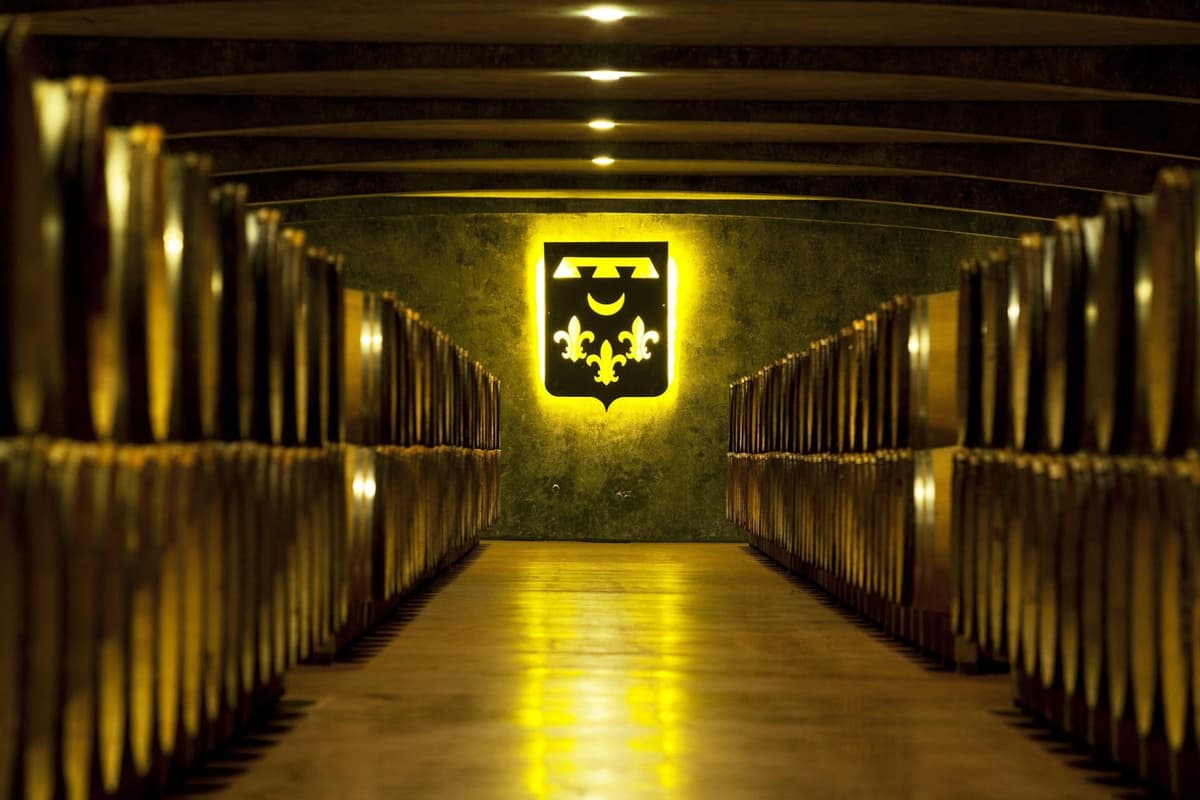
This is what a bookable cellar visit actually looks like: a working vault, a rank of barrels and somewhere to put the glasses. Photographed at Château de Pierreclos in the Mâconnais, which is not in the MICHELIN grape selection — the selection stops north of here.
What to do instead, and why it beats what you planned
Here is the reframe that makes a Burgundy trip work. The grape selection is a shopping list, not an itinerary. The region's visitor infrastructure was built by institutions, not by individual growers, and it is genuinely excellent. Four routes in, in rough order of reliability.
The Hôtel-Dieu and the November auction
The Hospices de Beaune keeps its own museum site, and the promise on it is short: faithful to its hospital tradition, the Hôtel-Dieu is open every day. In 2026 that means 9am–12.30pm and 2–6.30pm in the winter months, and 9am–7.30pm from 1 April to 15 November, with the ticket office closing an hour before. No appointment, no allocation, no relationship required.
The Hospices is also a 60-hectare wine estate, and its charity auction — first held in 1859 — is the fixed point of the Burgundy calendar. The 166th sale takes place on Sunday 15 November 2026 in the Halles de Beaune, conducted by Sotheby's, with more than 52 cuvées under the hammer and bidding open online, by telephone, in writing and in the room. It anchors the weekend known as Les Trois Glorieuses, and it is the one time of year when the region's doors open wider than usual, which is also why beds within reach of Beaune go early.
Château du Clos de Vougeot
Bought and restored by the Confrérie des Chevaliers du Tastevin in 1945 and turned into the seat of the order, the Clos de Vougeot is open every day. 10am–5pm from November to March, 9.30am–6pm from April to October. Guided tours run in English at 11.30am and 3.30pm, in French at 10.30am and 2.30pm, on reservation. If you want to stand inside the architecture of Burgundian winemaking rather than outside a locked gate, this is the visit.
The Cité des Climats and the Burgundy Wine School
The Cité des Climats et vins de Bourgogne runs three visitor sites (Beaune, Chablis and Mâcon, the last of them built inside the BIVB's own premises), and its public course programme is taught by instructors from the École des Vins de Bourgogne. The catalogue is wider than most people expect: a two-hour walk between vines and wines in the Côte de Beaune with a tasting stop in the vineyard, a half-day fundamentals course, a full tasting day, a discovery day with an estate visit and lunch, a session devoted to the grands crus. This is the honest substitute for the appointment you could not get: the same terroir, taught by people whose job is to teach it.
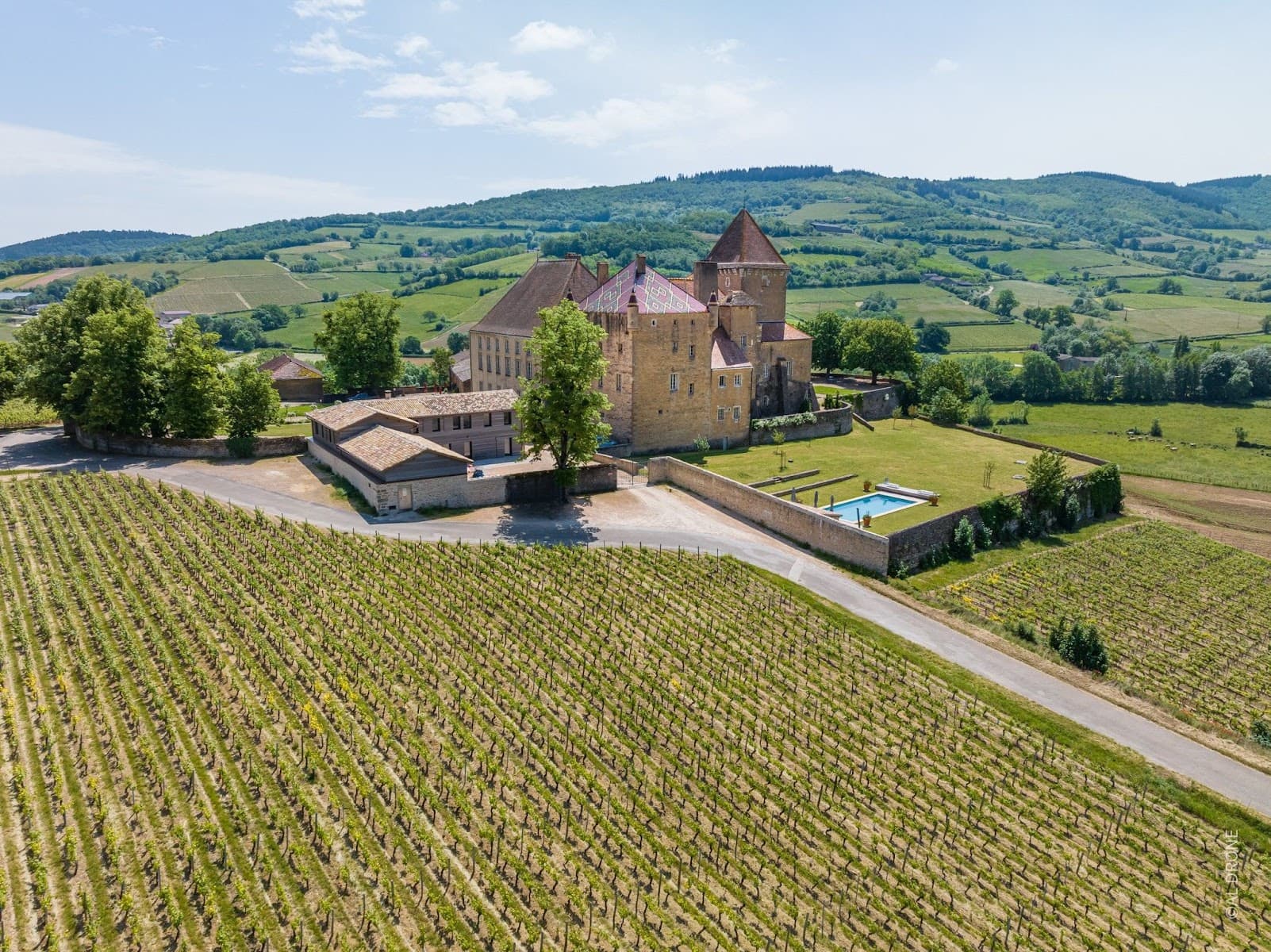
A guided tasting needs a room like this far more than it needs a famous label. Château de Pierreclos, southern Burgundy.
Village festivals, where the closed doors open
The single most effective way to get inside cellars that take no appointments is to go when the village opens them collectively. Berthaut-Gerbet, which reserves its own allocation for regular clients, publishes the Fixin open cellars of 5 and 6 December 2026 on its front page. And the Saint-Vincent Tournante — the winegrowers' festival that moves to a different Burgundy village each year — comes to Volnay on 30 and 31 January 2027, its third time there after 1957 and 1986. The programme is a procession of more than eighty confréries, a mass relayed to the village square, inductions into the Confrérie des Chevaliers du Tastevin, and tasting caveaux through the village.
One more label is worth knowing when you plan. Vignobles & Découvertes, created in 2009, is awarded for three years by Atout France on the recommendation of the Conseil Supérieur de l'Œnotourisme to a destination offering a complementary bundle: lodging, restaurants, cellar visits and tastings, museums, events. Four Burgundy destinations hold it: the Route des Grands Crus de Bourgogne; Couchois, Côte Chalonnaise and Mâconnais; the Route des vignobles de l'Yonne; and the Châtillonnais vineyard. A destination carrying it has, by definition, already assembled the things this article says are hard to assemble yourself.
Build the trip around the institutions first: the Hôtel-Dieu, the Clos de Vougeot, a Cité course, a village weekend. Treat any grower appointment you secure as the bonus it is. Do it the other way round and you will spend the week driving between closed gates.
Where to base yourself, and why the address matters more here
In a region where you cannot simply drive up and taste, geography does the work that a booking engine would do elsewhere. The right base is the one that puts you inside walking or ten-minute distance of the villages the selection concentrates on, and inside the catchment of the institutions above.
The Côte de Beaune: sleep between Meursault and Puligny
The 94 cluster heavily in a handful of Côte de Beaune villages: Meursault above all, then Puligny-Montrachet, Chassagne-Montrachet, Saint-Aubin and Volnay. Blagny is the hamlet sitting on the boundary between Meursault and Puligny, which makes it about as central as Burgundy accommodation gets. Saint-Aubin, Chassagne and Volnay are all short drives; Beaune and its Hôtel-Dieu are fifteen minutes away. You can walk out of the door into premier cru vines before breakfast. For a vineyard stay in this stretch of wine country, position beats almost every other consideration.
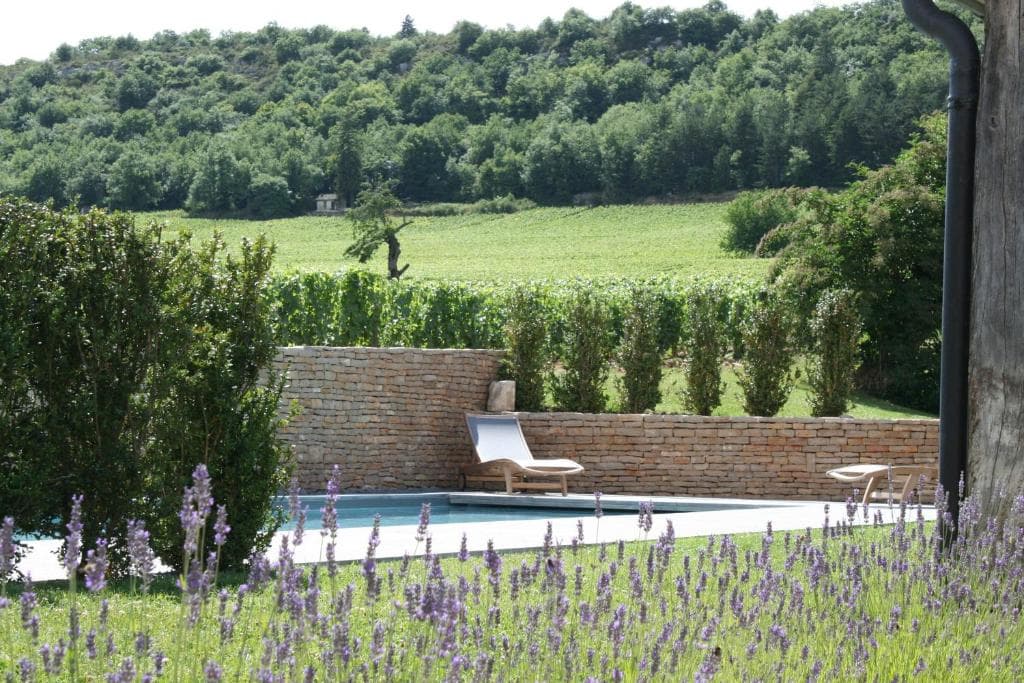
Le Hameau de Blagny, on the boundary between Meursault and Puligny-Montrachet — the vines beyond the wall are the reason to be here rather than in Dijon.
The Mâconnais: outside the selection, and easier for it
Worth saying plainly: the MICHELIN grape selection does not cover the Mâconnais at all. It stops at the Côte Chalonnaise. That is a reason to go, not a reason to skip it. The pressure that closes cellar doors further north is simply not present here, the Cité des Climats has its third site in Mâcon, and the châteaux that take guests do so as a matter of course. Château de Besseuil and Château de Pierreclos both sit in their own vines, an hour or so south of the Côte de Beaune, which makes a two-base trip perfectly workable: institutions and premier crus in the north, working estates and easier hospitality in the south.
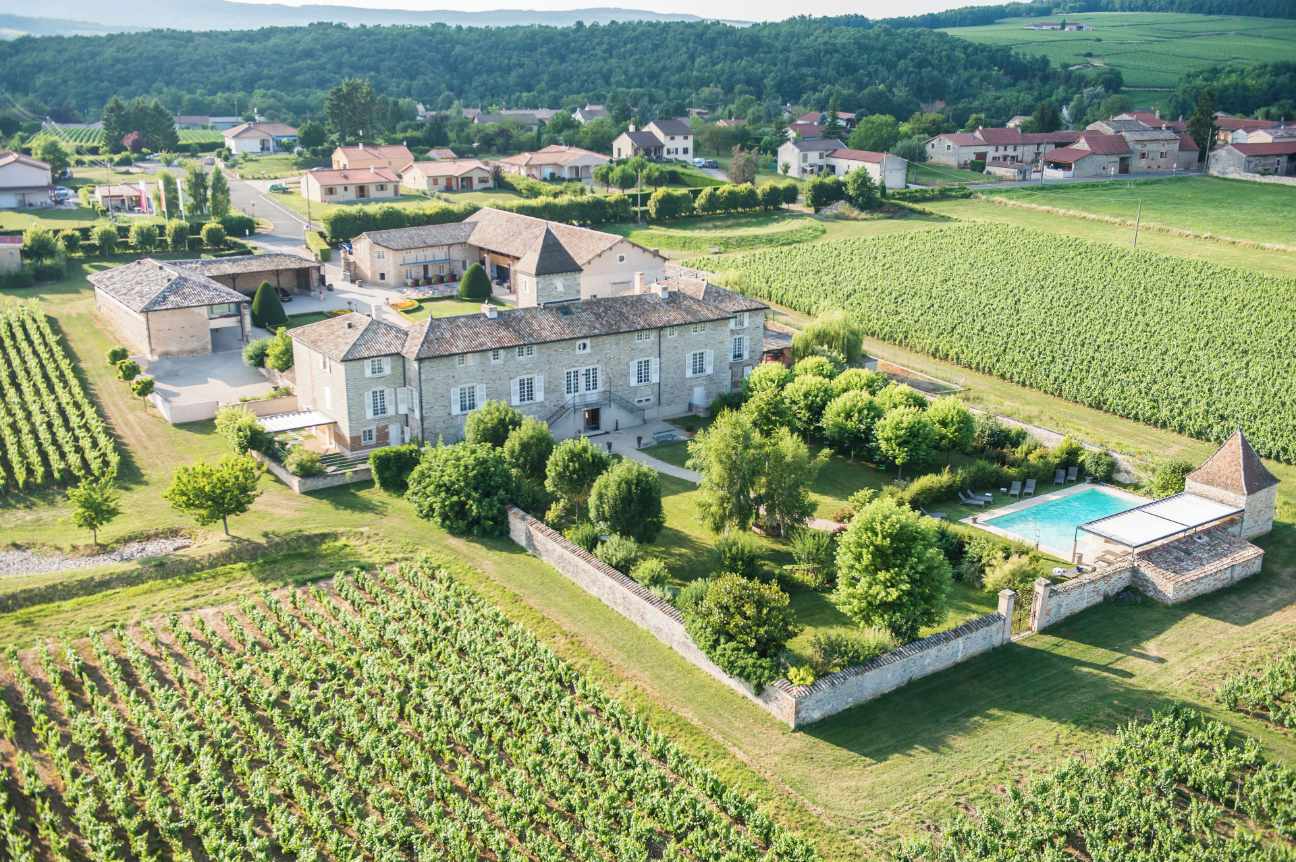
Château de Besseuil in the Mâconnais, with its vineyard running to the wall. Neither this property nor the region around it appears in the MICHELIN grape selection.
Three properties in our directory sit inside this plan. None of them holds a MICHELIN grape — the grape is not awarded to hotels, and no property in our catalogue could hold one.
The reason this article exists at all is that the grape is being read as a hospitality rating, which it is not. Keeping the four apart is the most useful thing a wine traveller can do with their attention:
MICHELIN grape — rates the wine a producer makes. Says nothing about visiting.
MICHELIN Key — rates a hotel as a place to stay. We covered what it measures in our guide to the Keys.
Best Of Wine Tourism — the Great Wine Capitals award that actually measures how an estate receives guests, explained here.
The World's 50 Best Vineyards — ranks the visitor experience, and requires an estate to be open to the public to qualify at all. Our breakdown of how that vote works explains why its list looks nothing like Michelin's.
If your question is "whose wine should I buy", the grape selection answers it. If your question is "where can I go, and who will let me in", the last two are the lists you want, and the four Vignobles & Découvertes destinations above are the map.
A note on sources
Every estate, house and institution named above links to its own website from the paragraph that discusses it, so the evidence for a claim sits beside the sentence it supports instead of in a pile at the bottom of the page. All of it was read on the publisher's own site in early September 2026, and the selection itself — the 94 names, the four tiers and the descriptions — comes from Michelin's press release of 7 July 2026. Visiting arrangements, opening hours and event dates are annual data and change without notice, so confirm directly before you travel.
Three addresses are deliberately not linked. The Dureuil-Janthial site in Rully is serving dozens of injected spam links alongside its own pages, and the domains a visitor would guess at for Coche-Dury and Domaine d'Auvenay are parked or listed for sale. None of the three is somewhere we are willing to send a reader.
 Alex Osso
 Build your own directory