Michelin named 94 Burgundy estates. We opened 33 of their websites: two sell a visit online, and none of the nine top domaines publish a bookable tour.
Until this August, a bottle from the village of Montpeyroux, in the Hérault, could only be labelled Languedoc Montpeyroux. The name existed, but it existed as a line item — one of ten complementary geographical denominations listed inside somebody else's rulebook, the cahier des charges of the AOC Languedoc. The rules that governed Montpeyroux sat in a table between Quatourze and Pézenas.
That ended with an arrêté of 11 August 2026, published in the Journal officiel on 15 August 2026 and in the agriculture ministry's bulletin on 20 August. Montpeyroux now has a cahier des charges of its own, running to its own chapters, with its own delimited area, its own grape rules and its own ageing calendar. The wines are reds and only reds.
This is worth more than a paragraph of trade news, because it is one of the few moments when the machinery of French appellation law becomes legible. A promotion like this is not a prize and not a rating. It is a document being rewritten, and almost every clause gets stricter. Below: what the new text tightens, how the map changed, what two new words are now allowed on the label, and the honest answer to the question that matters to anyone planning a trip through wine country — how much does any of this change what you can actually visit.
What Montpeyroux was before: a name inside another appellation
The AOC Languedoc is enormous. Its own text describes it as an appellation recognised by decree on 24 December 1985 under the name Coteaux du Languedoc, and its production area sprawls across the Hérault, the Gard, the Aude and the Pyrénées-Orientales — hundreds of communes. Inside that appellation, a handful of places are singled out as dénominations géographiques complémentaires, or DGCs: names that may be appended to the appellation on the label, and that come with production rules stricter than the regional baseline.
In the version of the Languedoc rulebook homologated on 18 November 2024, the DGC list runs: Cabrières, La Méjanelle, Montpeyroux, Pézenas, Quatourze, Saint-Christol, Saint-Drézéry, Saint-Georges-d'Orques, Saint-Saturnin, Sommières. Compare that with the version homologated on 23 November 2022 and one name has vanished from the list — Grés de Montpellier — which is exactly what a promotion looks like from inside the parent document. A DGC does not get upgraded so much as it leaves.
As a DGC, Montpeyroux was defined in the Languedoc text as two communes of the Hérault: Arboras and Montpeyroux. Its grapes were three principal varieties — grenache N, mourvèdre N and syrah N — with carignan N and cinsaut N as accessories. Three varieties had to be present in the vineyard; the principals had to make up at least 60% of the holding, none of the three could exceed 75%, and mourvèdre plus syrah together or separately had to reach 20%. Yield was capped at 42 hectolitres per hectare with a hard ceiling (rendement butoir) of 50, minimum natural alcohol was 12%, and the reds had to be aged at least until 15 August of the year following the harvest.
Hold those numbers. They are the baseline against which the new appellation was written, and the comparison is the whole story.
What the new rulebook tightens
A useful rule of thumb when reading any French promotion: the new text is the old text with the screws turned. Montpeyroux is a textbook case, and the tightening is not cosmetic.
Carignan is promoted with the appellation
The most interesting single change is a variety changing rank. In the new cahier des charges the principal varieties are grenache N, mourvèdre N, syrah N and carignan N; the accessories are cinsaut N, counoise N and morrastel N. Carignan, an accessory grape in the DGC, is now a pillar of the appellation.
That is not a fashion decision. The appellation's own account of its history records that after the phylloxera crisis the vineyard was replanted from 1886 principally around carignan noir, with cinsaut and grenache in support. Promoting carignan writes the village's post-phylloxera identity back into law, at a moment when much of the Languedoc has spent forty years pulling it out.
The proportions moved with it. At the level of the holding, three varieties are still obligatory, but the principals must now reach 75% of the plantings rather than 60%, and no single principal may exceed 70% rather than 75%. Mourvèdre and syrah, together or separately, still have to reach 20%. Counoise and morrastel are capped together at 10%. And there is now a separate rule for the blend itself: a wine must come from at least three varieties including two principals, the principals must make up at least 70% of the assemblage, and no variety may exceed 70% of it. In other words, a single-variety Montpeyroux is not possible, by construction.
Riper grapes, less wine
Minimum sugar at harvest rises from 202 to 204 grams per litre of must, and minimum natural alcoholic strength from 12% to 12.5%. The base yield stays at 42 hectolitres per hectare from the sixth leaf, but the hard ceiling drops from 50 to 45 — the number the trade press has been quoting as « the » yield, when it is in fact the ceiling. Vines in their fifth leaf are held to 35 hl/ha.
Density, with a memory of when the vine was planted
Rather than one density figure, the text sets three, keyed to planting date: at least 4,400 vines per hectare for vineyards planted from 10 November 2011, at least 4,000 for those planted between 22 August 1990 and 9 November 2011, and at least 3,300 for anything older. Rows may not exceed 2.25 metres. Crucially, the older and sparser plots are not simply grandfathered in — they carry lower yields of their own: 38 hl/ha (ceiling 41) in the 4,000–4,400 band, and 32 hl/ha (ceiling 34) below 4,000. Old vines keep their place in the appellation and pay for it in volume.
Pruning is short, on spurs, with a maximum of ten buds per vine and two per spur. Syrah must be either staked on échalas or trellised with at least one level of lifting wires. Chapter XI of the document, where transitional measures usually soften the blow for existing growers, reads in full: Sans objet. Nothing to declare. There is no grace period.
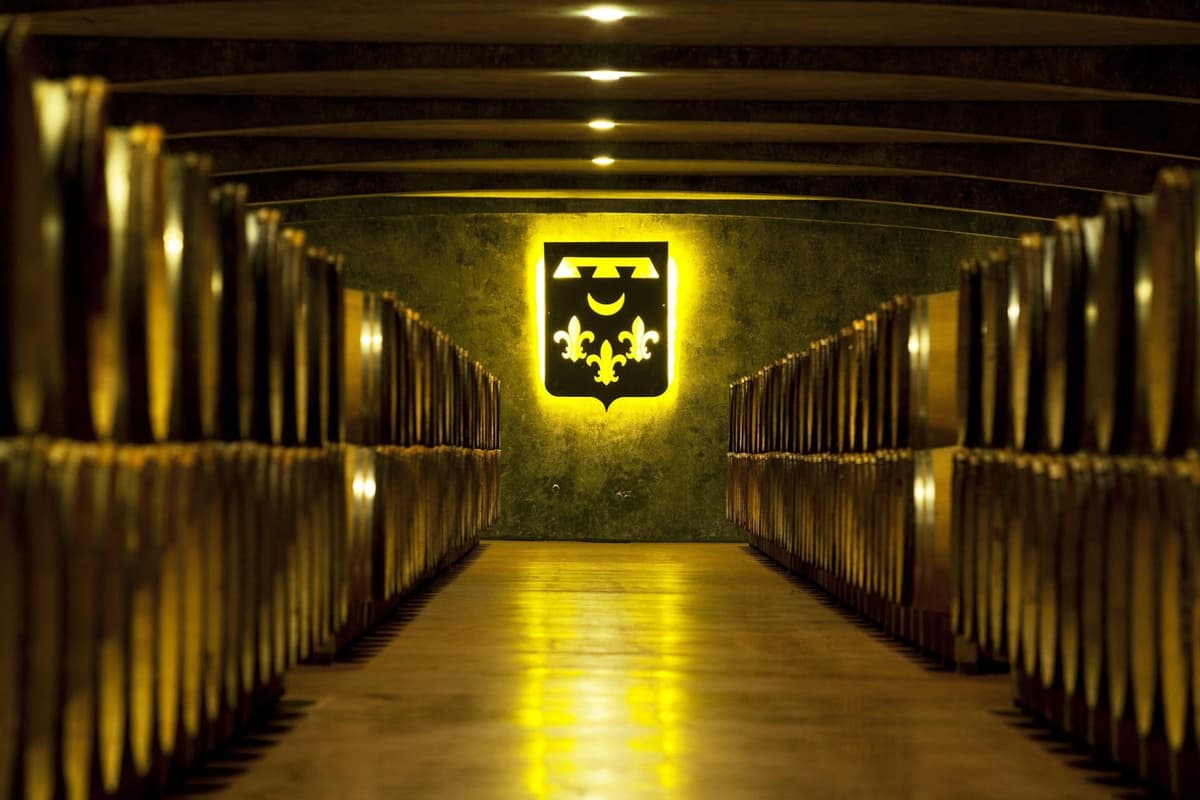
A cahier des charges reaches into rooms like this one: the Montpeyroux text bans oak chips, heating must above 40 °C, continuous presses and continuous vinifiers outright. Pictured is Domaine Riberach in Roussillon, not Montpeyroux — the rules described here apply to the Hérault appellation.
Two more months in the cellar
The DGC required ageing until 15 August of the year after harvest. The appellation requires it until 15 October, and adds a release date the DGC rules did not impose in the same form: the wines may go to the consumer from 1 November of the year following the harvest. On paper that is a two-and-a-half month delay. In practice it means a Montpeyroux is, by law, an eighteen-month-old wine at the earliest — and that a bottle from the 2026 harvest cannot legally reach a shop shelf or a restaurant list before November 2027.
If you are planning a tasting trip and want to drink the appellation as the new text defines it, that release rule is the date to keep in mind. Vintages currently in circulation were made under the older DGC rules; the first wines produced entirely under the standalone appellation reach the market on a schedule set by the cahier des charges, not by the producer.
The map moved too
A promotion is also a redrawing. As a DGC, Montpeyroux covered two communes. The appellation covers four: Arboras, Montpeyroux, Lagamas and Saint-Jean-de-Fos, defined on the 2024 official geographic code. Lagamas and Saint-Jean-de-Fos were previously in the DGC's aire de proximité immédiate — the surrounding zone where wine may be vinified and aged by derogation, but where the grapes do not come from. They have crossed the line inwards.
The proximity zone, meanwhile, shrank hard. Under the DGC it listed twelve communes, from Aniane and Gignac to La Vacquerie-et-Saint-Martin-de-Castries. The appellation lists two: Jonquières and Saint-Saturnin. The parcel-level delimitation was approved by the INAO national committee at its session of 12 June 2025.
The document is unusually good on why this particular patch of ground is worth ring-fencing. Montpeyroux means mont pierreux — stony mountain — in Occitan, and the appellation sits against the southern foothills of the Larzac, about 40 km west-north-west of Montpellier, north of the A750. Mont Baudille closes the horizon to the north at 848 metres. The vineyard climbs from 100 to 350 metres, crossed by the Lagamas to the west and the Avenc stream to the east. Rainfall averages 750 mm a year with a pronounced summer trough of around 120 mm.
The soils, in the text's own summary, are varied but share a constant: an omnipresent limestone component, Permo-Triassic marls enriched with limestone scree, hard dolomitic limestones, and a stony plateau formed from a quaternary frost-shattered outwash with a red-tinted matrix. All of them low in fertility, stony, and well drained. The village sits on five distinct geomorphological formations — three levelling surfaces at different heights alternating with two softened hill formations.
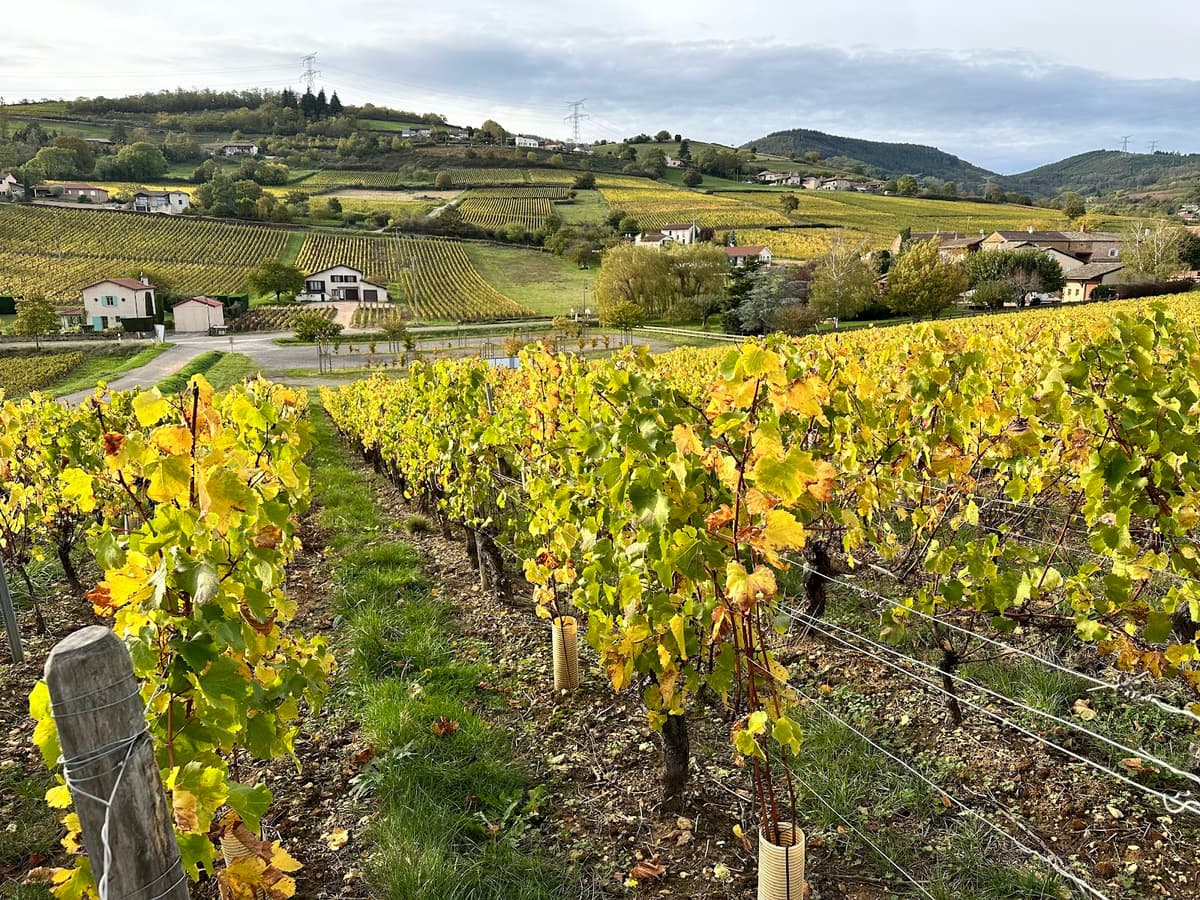
Garrigue and limestone: the landscape type the Montpeyroux text describes as low-fertility, stony and free-draining. This view is from Domaine Riberach in the Roussillon, further south along the same Mediterranean arc.
« Cru du Languedoc »: two words the label may now carry
Here is the clause that will change what you see on shelves. The Montpeyroux cahier des charges permits the larger geographical unit Languedoc to appear on the label under the heading « cru du Languedoc », in characters no more than half the size of the appellation name. The vintage is compulsory.
Read that carefully, because the hierarchy has inverted. Before, Languedoc was the appellation and Montpeyroux the qualifier appended to it. Now Montpeyroux is the appellation and Languedoc is an optional, smaller, subordinate mention — and the word attached to it is cru. The same inversion is written into the Grés de Montpellier text homologated on 1 July 2025, which allows « Languedoc » as the larger geographical unit at half character size.
For a region that has spent three decades trying to explain that it is not one undifferentiated sea of red wine, this matters more than the yield numbers. The Languedoc is building a pyramid, and the appellations at the top of it are now allowed to say so in the language French wine drinkers already understand.
What a promotion changes first is the front label. The bottle shown is from Domaine Riberach in the Roussillon and is not a Montpeyroux — it is here to illustrate where the appellation name and the « cru du Languedoc » mention would sit.
How a French appellation is actually promoted
The arrêté is the last step, not the process. When the INAO's national committee for wine appellations reported on its session of 11 and 12 June 2025, it described the Montpeyroux application as the product of six years' work by a group of growers, and did two things at once: it approved the cahier des charges, and it recognised the Syndicat de l'AOC Montpeyroux as the appellation's management body — its ODG, the organisation that will run internal controls and defend the name.
The same INAO report gives the shape of the application: four communes, almost 595 hectares, 22 wineries behind the file, and annual production of about 4,000 hectolitres. To put that in perspective, 4,000 hectolitres is roughly what a single mid-sized cooperative elsewhere in France makes in a good year. This is a small appellation by design.
What comes between committee approval and the arrêté is worth knowing, because it explains why these things take years and why the trade press often reports the same promotion twice. The Grés de Montpellier file shows the machinery in full: a first arrêté on 14 May 2024 homologated the cahier des charges but made itself conditional on the European Commission cancelling the old DGC registration and registering the new PDO; transitional national protection then took effect on 16 July 2024, the date the registration request was filed in Brussels; and the operative homologation followed by arrêté of 1 July 2025, published in the Journal officiel on 3 July 2025. Three official dates, one promotion.
And Montpeyroux is not the end of the queue. At that same June 2025 session, the committee validated the public consultation on the draft geographical areas for a future AOP Cabrières — currently still a DGC of the Languedoc — and for a new DGC Cazelles within the Minervois, describing both as a further stage in the qualitative hierarchisation of the Languedoc appellations.
Do not read an appellation promotion as a quality verdict on individual producers. A cahier des charges sets production conditions for a delimited area — varieties, densities, yields, ripeness, ageing. It says nothing about which estate in that area makes the better wine, and nothing at all about whether any of them will let you in.
What it means if you are planning the trip
Here is where we have to be straight with you. Montpeyroux is a village of a few hundred hectares of vines at the foot of the Larzac, and there is no winery hotel in our catalogue inside the appellation. There is no point pretending otherwise. What the appellation gives a traveller is a reason to point the car at a specific corner of the Hérault that most itineraries skip in favour of the coast.
The geography does a lot of the work. Saint-Jean-de-Fos, one of the four communes now inside the appellation, sits at the mouth of the Hérault gorges below Saint-Guilhem-le-Désert; the D130 climbs from Montpeyroux towards Arboras and the Larzac escarpment. The vineyard runs from 100 to 350 metres, which in practice means the difference between a warm valley floor and genuinely cool evening air within a few kilometres. Montpellier is about 40 km away.
For vineyard stays, the realistic bases are elsewhere in the Languedoc and the Roussillon — a drive away rather than a walk, and worth planning as such. These are the two properties in our catalogue in the wider region:
Hotel
4.5(533 reviews)
Domaine Riberach
Languedoc-Roussillon, France
Starting from
$235 /night
Château & Village Castigno sits in Assignan, in the Saint-Chinian country west of Béziers — a different appellation and a different landscape, roughly an hour and a half from Montpeyroux by road. Domaine Riberach is further south again, at Bélesta in the Roussillon, in a converted cooperative winery. Neither is in Montpeyroux, and neither claims to be; both put you inside the same Mediterranean arc of limestone, schist and garrigue that the Montpeyroux text spends two pages describing.
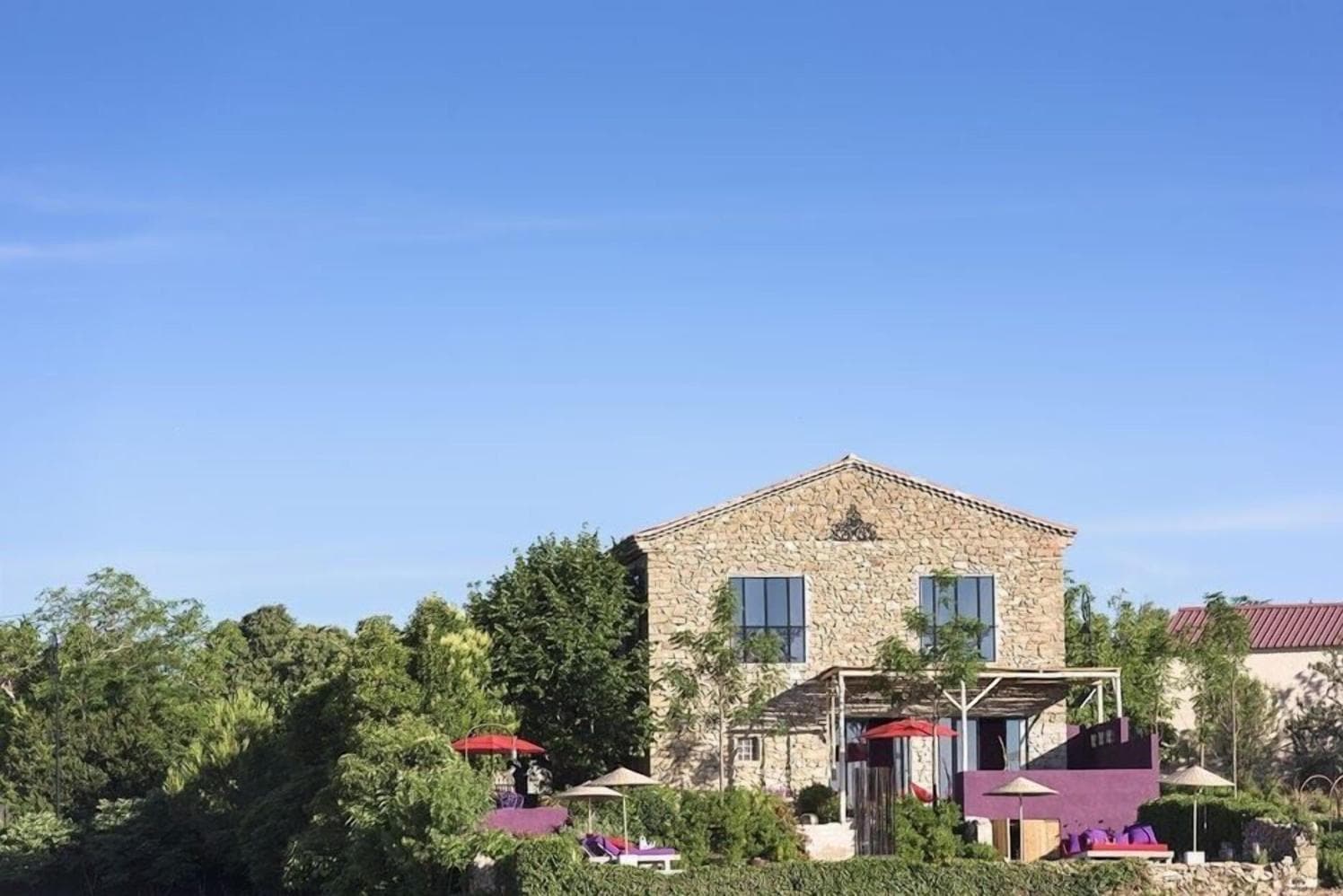
Village stone and garrigue at Château & Village Castigno in Assignan, Saint-Chinian — about ninety minutes' drive from the new Montpeyroux appellation.
Go for the geology, not the label. The appellation's case rests on five geomorphological formations in a few square kilometres. Driving the D130 from Montpeyroux up towards Arboras takes you across most of them in twenty minutes.
Ask what is in the blend. With carignan now a principal variety and no wine allowed to exceed 70% of a single grape, the interesting question at a tasting counter has become an arithmetic one.
Treat the release calendar as part of the trip. Reds cannot be sold to consumers before 1 November of the year after harvest, so what is open in a tasting room in spring is always at least a year and a half old.
Do not assume a promotion means open doors. Appellation status is a production rule. Visits, opening hours and tastings are decided estate by estate, and the only reliable source is the producer's own site.
The village is at the foot of the Larzac and beside the Hérault gorges, which makes it easy to pair a morning of wine tasting with an afternoon that has nothing to do with wine at all — Saint-Guilhem-le-Désert and the Pont du Diable are minutes from Saint-Jean-de-Fos, inside the new appellation boundary.
What a new appellation does not tell you
It is worth saying plainly, because the vocabulary of French wine encourages the opposite reading. An AOC is not a score. It does not rank producers, it does not certify hospitality, and it carries no information whatsoever about whether an estate has a tasting room, a booking page or a bed.
That confusion is now easy to fall into, because a wine traveller in France is looking at several unrelated marks at once. An appellation is a production rulebook set by a regulator. The MICHELIN grape is a judgement on a wine producer. The MICHELIN Key is a judgement on a hotel. The Best Of Wine Tourism awards judge how an estate receives visitors, and The World's 50 Best Vineyards is a poll of a voting academy. Five instruments, five different questions. Montpeyroux's promotion answers only the first.
If you want to see how differently national systems answer that first question, the comparisons are instructive: Italy stacks DOCG, DOC and IGT into a national pyramid, Spain runs a different rulebook for each denomination around a single grape, and France writes one document per appellation — which is precisely why a village leaving its parent text is such a decisive event. AOC Cahors shows what a single-village French cahier des charges looks like once it has had fifty years to settle. Our France collection covers the estates and winery hotels across the rest of the country.
Sources & Further Reading
Appellation texts are revised: figures such as yields, densities and delimited areas are valid for the version cited and are superseded whenever a new cahier des charges is homologated. The links below are the documents we opened; every number above comes from one of them.
BO-AGRI, French Ministry of Agriculture — cahier des charges of the AOC « MONTPEYROUX » — the source for the arrêté of 11 August 2026 and its JORF publication of 15 August 2026, the four communes and the proximity zone, the principal and accessory varieties, the 75% / 70% / 20% / 10% proportions, the blending rules, the three density bands and their yields, 204 g/l of sugar and 12.5% natural alcohol, the ageing to 15 October and release from 1 November, the « cru du Languedoc » labelling clause, the banned cellar practices, the geology and altitudes, and the « Sans objet » transitional chapter.
BO-AGRI — cahier des charges of the AOC « Languedoc », homologated by arrêté of 18 November 2024 — the source for everything Montpeyroux was as a DGC: the list of ten complementary geographical denominations, the two communes of Arboras and Montpeyroux, the twelve-commune proximity zone, the three principal varieties with carignan as an accessory, the 60% / 75% / 20% proportions, 202 g/l and 12%, the 42 and 50 hl/ha yields, and ageing to 15 August.
INAO — report of the Comité national des appellations d'origine, session of 11 and 12 June 2025 — the six years of work behind the file, the approval of the cahier des charges and the recognition of the Syndicat de l'AOC Montpeyroux as the management body, the figures of almost 595 hectares, 22 wineries and 4,000 hectolitres, and the parallel consultations on the future AOP Cabrières and the DGC Cazelles in the Minervois.

 Alex OssoSep 8, 2026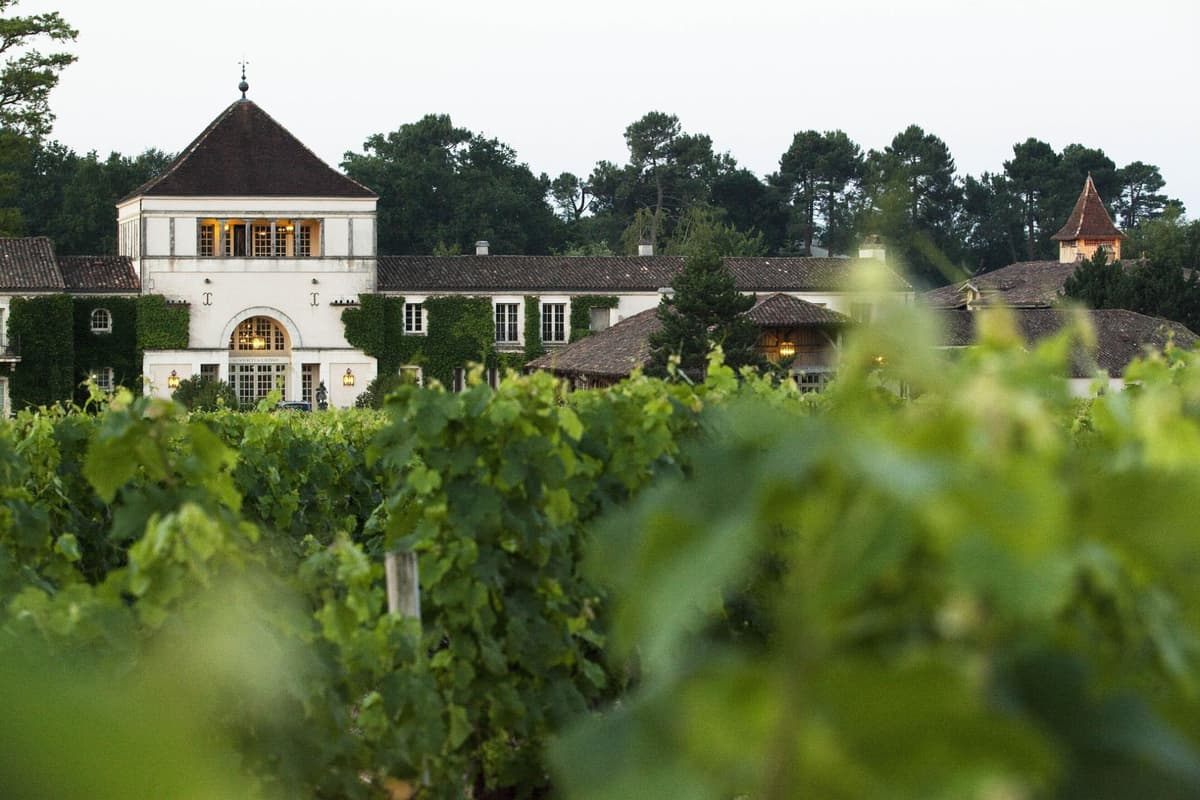

 Build your own directory